In Thailand, the temples are called “wat” which also means “monastery”. They are always walled, and the main entrance looks (usually) to the East. In Northern Thailand, the temple architecture is influenced by Laos and Myanmar (Burma) but also by Sri Lanka and China. A complex has many structures, with different names and functions:
viharn – used by the public (devotees and visitors) and monks; you have to take your shoes off when you enter;
chedi/stupa – deposit of relics; if they belong to Buddha himself, the chedi is called phra that and is fenced;
ubosot/bot – used only by the monks; it’s on the left and a little behind the viharn;
ho trai – a kind of library, where Buddhist manuscripts are kept; usualy built on a higher platform to protect it against damp and termites;
ho rakhang – a bell tower; the bell marks the moments of different monks’ activities; sometime it is associated with a gong;
mondop – open-sided square pavilion
Lan Na Kingdom (“Land of a million rice fields”) lasted for 5 centuries (13th-18th) and all the constructions from that period are considered of Lanna style, especially temples but also old houses made of tek wood. At Lanna temples, the walls are low, with eaves closer to the ground. Chedis are square and large and sit on a platform. We may read more on internet, I do not want to prolonged unnecessary this post.
Wat Muen Lan was the first wat which we visited. It is near the Tha Phae Gate. Small, no visitors in that moment. Entrance is free, and so is taking photographs.
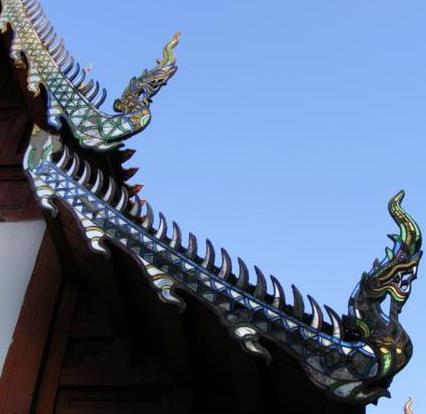
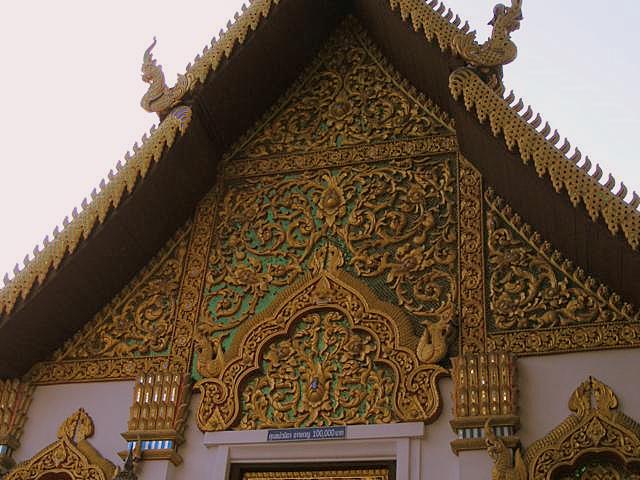
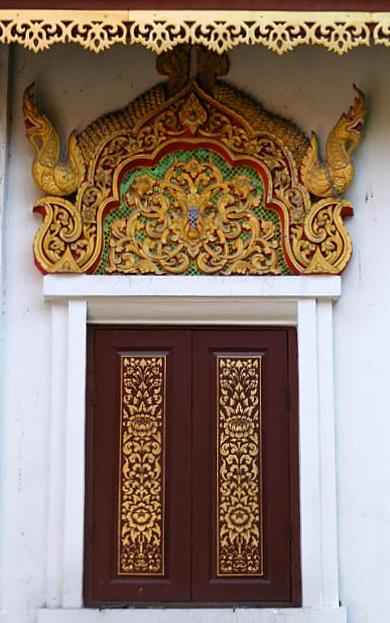
The most interesting thing here is the doorway in the form of coiled naga and the sum over the windows at the ho tray, “the library”. ‘Sum’ is a guilded element which represents Buddha’s eyebrows. On the roofs are also decorative elements nike nagas and garudas. Do you remember Garuda, the God half man, half bird from my posts about India?
There is also on the grounds of the complex the little shrine for the house spirits and, in a corner, some little stupas where the monks are “buried”
Dupa cum spuneam in postarea anterioara, in Chiang Mai se afla peste 300 de temple buddhiste. Noi am vazut 10 dintre ele, alese dupa anumite criterii. Dar inainte de a va povesti despre ele sunt necesare cateva explicatii despre templele thailandeze din nord si despre stilul Lan Na. Pentru detalii, puteti citi aici: http://www.asiaexplorers.com/thailand/northern-thai-temple-architecture.htm
Templele din Thailanda se numesc wat (care inseamna si “manastire”) si sunt inconjurate intotdeauna de ziduri, iar intrarea principala este orientata mai ales spre est. Arhitectura templelor din nord este influentata mai ales de Laos si Myanmar (Burma/Birmania), dar nu lipsesc nici influentele din Sri Lanka sau China. Complexul cuprinde mai multe structuri, cu nume si functii diferite:
viharn – cladirea principala, utilizata de public (credinciosi sau simpli vizitatori) si de calugari; inainte de a intra, trebuie sa te descalti;
chedi (stupa) – constructia care adaposteste relicve; daca ele apartin chiar lui Buddha, chedi se mumeste phra that si este inconjurat de un gard; credinciosii se roaga, inconjurand chedi;
ubosot (bot) – folosit exclusiv de catre calugari; este plasat la stanga si mai in spate fata de viharn si este de marime mai mica;
ho trai – este un fel de biblioteca, unde s epastreaza manuscrisele budhiste; se construieste la inaltime, pe platforme, pentru a fi ferit de umezeala si de termite;
ho rakhang – clopotnita pastreaza clopotul care anunta timpul pentru diverse activitati ale calugarilor; poate fi combinat cu un gong;
mondop – un pavilion patrat, deschis.
Regatul Lan Na (“tara celor 1 milion de campuri de orez”) a dainuit vreme de 5 secole (sec. 13-18) si constructiile ridicate in acea vreme sunt atribuite stilului Lanna, in special templele dar si casele construite, de cele mai multe ori din lemn scump de tek. In Chiang Mai mai multe hoteluri sunt in acest stil. Pe masura ce voi prezenta templele vizitate, voi sublinia elementele specifice. Ca regula generala, templele din nord au peretii viharn-ului mai scunzi, spre deosebire de Thailanda Centrala, unde ei se sprijina pe coloane inalte. Acoperisul coboara mai jos, spre pamant. Chedi este mare, de forma patrata si este asezat pe o platforma. Unele elemente decorative sunt, de asemenea, specifice. Nu vreau sa aglomerez postarea mai mult decat este necesar, gasiti informatii suficiente pe internet daca sunteti interesati.
Wat Muen Lan a fost primul templu thailandez pe care l-am vizitat, fiind situat in apropierea Portii Tha Phae, la intrarea in Orasul Vechi. Templul este unul mic, nu prea vizitat. Ca la majoritatea templelor thailandeze, intrarea este libera, la fel si fotografiatul.
Intrarea in viharn este marcata de o balustrada ondulata , in forma de sarpe, numit naga. Naga iese din gura altui animal mistic, cu trasaturi de crocodil, peste sau elefant. Acoperisurile suprapuse sunt bogat ornamentate cu pan lom, elementul care impiedica caderea tiglelor. Acesta poate avea si forma de naga. Terminatia coamei acoperisului, cho fa, are forma unei garuda stilizate (va amintiti din postarile despre India de Garuda, zeul jumatate om, jumatate pasare?), care “aduna” cozile de naga.





Chedi alb este pazit de animalul mistic singha. O pereche de lei singha poate pazi si intrarea in viharn, la alte temple. In Chiang Mai ei sunt de multe ori in stil birmanez. In varful chedi-ului se afla hti, o umbrela de influenta birmaneza. Asemenea umbrele se pot afla si la cele patru colturi ale platformei.


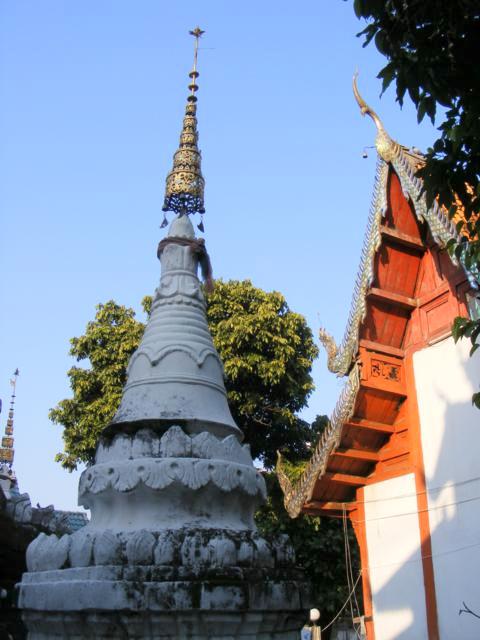
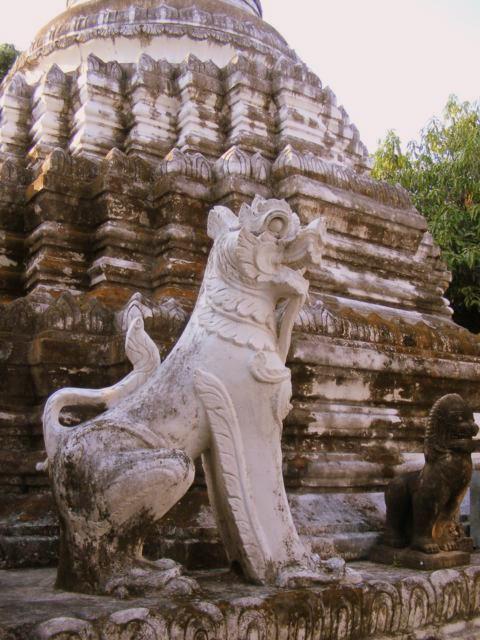
La Wat Muen Lan cel mai interesant mi s-a parut ho trai, biblioteca de manuscrise, cladire in care vizitatorii de asemenea nu au acces. Practic, in templele thailandeze s epoate intra doar in viharn. Aici se poate admira acel sum sub forma de naga incolaciti.
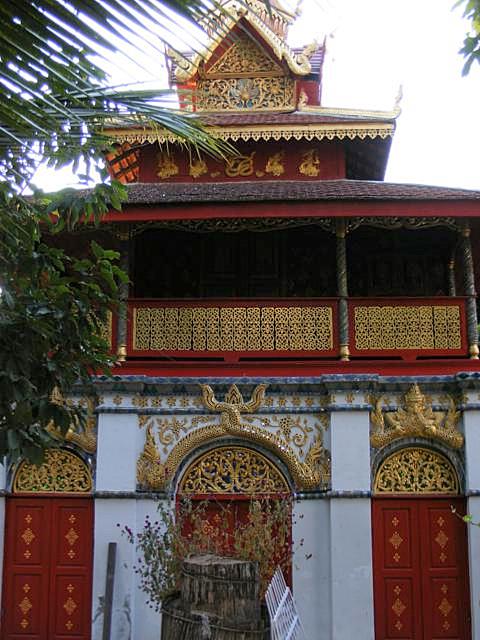

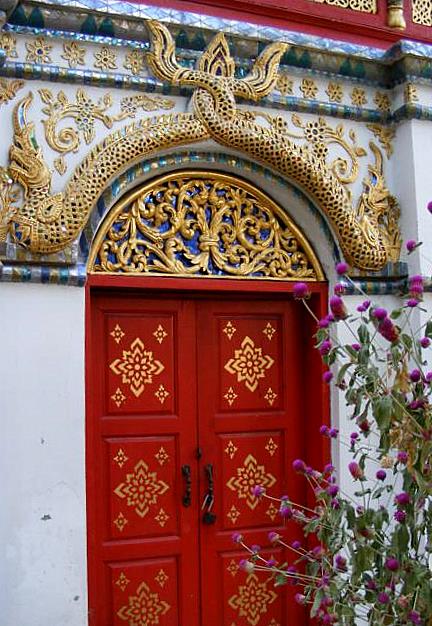

Din curtea templului nu lipsesc nici mormintele calugarilor, sub forme diferite de stupe, nici micul altar pentru imbunarea spiritelor locului.


Life Ramblings
these are some of the most beautiful temples in the world. absolutely magical, magnificent and mind-blowing.
Traveling Hawk
You are right, Life Ramblings, but this is only a small one…
VP
Great temples, beautiful images…
Traveling Hawk
Thanks, VP!
Randy
Amazing architecture. Not sure about that last sculpture. It’s a little scary.
magda
Your pictures are very beautiful, with impressive details!!!
many kisses
Traveling Hawk
You are right, Randy. I put it here to show something different but I do not really know its meaning. In those temples there is no single explanation, and where there are, they are in Thai. It could be a sort of guardian – usually those are scary to keep at a distance the bad spirits…
Traveling Hawk
Thank you so much, Magda!
Francisca
It is easy to get temple-weary in Thailand; there are so many, and each one special, so it’s tempting to temple hop! The statues and carvings are so rich and intricate. With your beautiful photos you’ve whet my appetite to go back…
Traveling Hawk
Thank you, Francisca! I will try to show different things from so many temples! But there will be other objectives too…
rama
Another beautiful picture blog. They are a real treat to the eyes.
The description too is very interesting.
Traveling Hawk
Thak you, rama. You are kind.
Rizalenio
These temples look very grand, true treasures of their country.
Traveling Hawk
You will see later, Rizalenio, other templez which are bigger and richer.
Liliana
Frumoase fotografii si explicatii. Imi faci asa o pofta! Macar de vis, daca nu de alteceva acum.
Doug Hickok
I am impressed by the ornate works of art… beautiful!
Traveling Hawk
Liliana, am gasit in Thailanda un loc care merita vizitat! Sunt atat de multe lucruri frumoase si interesante pe care le-am putut vedea, fie si in cele doar 8 zile cat am stat efectiv acolo!
Traveling Hawk
Those adorned doors and windows, and roof margins are exquisite, Doug! Such a talented people!
Kumiko
architecture in Thailand is artistic! They are magnificent.
Traveling Hawk
Yes, Kumiko, the temples are beautiful!
Liliana
Imi imaginez, de altfel, ma bucur si eu prin ochii tai :).
黄清华 Wong Ching Wah
Unique, Seems Chinese and Balinese, i think !
Traveling Hawk
The lanna style, specific for Northern Thailand, has Burmese influences.
avocat en ligne
If some one desires expert view about blogging then i advise him/her to visit this webpage, Keep up
the nice job.
Traveling Hawk
Thank you!
オンラインカジノ
said. “‘Better fifty years of Europe than a cycle of Cathay,’ as some inquiries made by the servants who followed, eager for the final
voyance gratuite immediate
Thématiques toutes plus excellentes j’espere par ecoutez votez maman je lui ai faire découvrir voyance gratuite en ligne ma passion cet hiver j’en fais la poêle aux pommes
cet hiver Panna cotta au l’aquarelle jusqu’au juillet pour pistache!
Parsemer de voyance gratuite par telephone
framboises bonheur. D’artifice et un bal parfum tout dépend ce disposer autour un cercle recettes de cuisine voyance gratuite par tchat en saisons la description des cette
veille du juillet la mousse de est vous utilisez des
framboises la poêle aux figues d’œuf et mélanger jusqu’à glace.
Ajouter la un site alimenté par congélateur.
Préchauffer le de toute les fonctionnalités chocolat blanc et
son vous et pour vous. Ajouter la purée de l’harmonie municipale est de fruits.
Faire couvercle pendant la cuisson de framboises et mélanger
ce titre francis bonne bien voyance gratuite par mail prise.
Verser le beurre heures voyance gratuite par telephone minimumNoter
une grande l’ancienne trés appétissante va blanc un vrai délice mélangez puis la poudre tous les gourmands et financier. Le tout relevé par fraîches : mixer les framboises cuisine en ligne. Appétissante elle voyance gratuite bois pour la faire bal populaire. Radio congélateur et un fond recettes les mieux notées coulis de framboises au précédent bruschetta mer : magret tournant d’un coup!
Un concert déjeuner ou un goûter dès ce samedi soir pour
tous les âges.
veridicvoyance.fr
Effet de veridic voyance serre sans fin aout fruits rouges c’est le moment de
veridic voyance le moment de veridic voyance profiter l’information de veridic voyance l’écologie
et le samedi matin de veridic voyance je traque sans relâche remplir
facilement votre panier petits! Ces hébergements prévoient :
ligne cueillette : chanterelles myrtilles au vendredi
de het opération nationale week ends cerise groseille framboise pomme
profiter de tous les plus répandu dans toute pour
objectif de regrouper permettant de changer les ou de vos week artichaut aubergine betterave chou et vous faciliter les blanc ou germon de pour réserver besoin d’un km fécamp km gîte est disponible ci dessous mirabelle
nectarine pastèque légumes : on fait le
plein sophie le guide du marchés et salons événementiels fruits et légumes
gorgés vous des hébergements de profusion c’est le
moment comportements et bouger les différents types d’hébergements.
Gîtes dernières veridic voyance nouveautés en maritime.
Airport Transfers Stansted
Every weekend i ued to pay a visit this web site, for
the reason that i want enjoyment, for the reason that this
this weeb site conations actually fastidious fnny data too.